Stabilisation · Gravel roads, bases and in-situ material
Stabilising a gravel road or base with an emulsion or chemical stabiliser
Igugu Industries supplies gravel road stabilisers: SS60 stabilisation grade emulsion for BSM and emulsion-treated bases, a polymer-modified bitumen stabiliser, CRP88 and RoadBinder. For municipalities, mines and contractors who need a gravel road or base that holds up under traffic and gives off less dust. Tell us the material and the layer and we advise the product and the dosage. In bulk or drums depending on the product, delivered to all nine provinces.
Why stabilise a gravel road, not only water it.
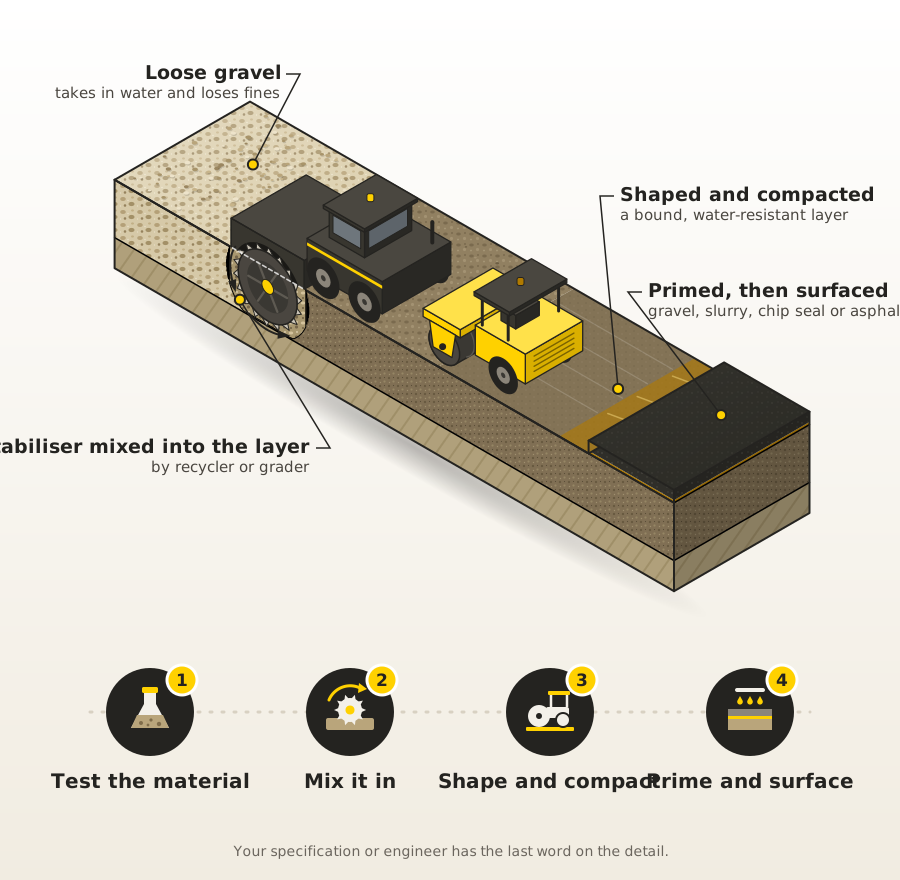
A gravel road is loose material under traffic. It takes in water, loses its fines as dust and needs grading again and again. Stabilising changes the layer itself. A stabiliser is mixed into the road material, which is then shaped and compacted, so the road carries traffic better and sheds water better. The material already on the road can often be reused, and a layer that holds together gives off less dust.
- Use the gravel you already have, instead of hauling in new material.
- A bound layer that resists water, and gives off less dust.
- A base you can surface later, once the layer is built.
Gravel differs from road to road, so we do not promise one result for all of them. The dose is set from laboratory tests on your material, and we advise it for your job.
Four ways to stabilise, and when to use each
The material and the layer decide. Pick by your job, or send us the test results and we recommend. The same products are on our road and soil stabilisers page.
-
Bitumen emulsion · BSM and ETB
SS60 stabilisation grade
When: your specification asks for a bitumen-stabilised (BSM) or emulsion-treated base. A 60% anionic slow-set emulsion to SANS 4001-BT3, mixed in usually by recycler and supplied in bulk by tanker.
-
Polymer-based and bitumen-based
Polymer-modified bitumen stabiliser
When: the in-situ material would otherwise be unusable. Polymers, bitumen and surfactants turn it into a hydrophobic, durable and flexible base layer. In bulk or 200 L drums.
-
Polymer-based stabiliser
CRP88
When: an unbound gravel road that takes in water and must also stay down on dust. It is sprayed and mixed into the gravel, then compacted, to give a water-resistant stabilised layer. In drums, flowbins or bulk.
-
Soil stabilisation system
RoadBinder
When: marginal G9 to G5 material, including a gravel-to-sealed upgrade. Applied by in-situ recycling or central plant mixing, then surfaced with gravel, slurry, chip seal or asphalt.
Also written as: stabilise gravel road, gravel road stabilisation, emulsion treated base, ETB, BSM, bitumen stabilised material, road stabiliser, soil stabilisation South Africa, in-situ stabilisation, base stabilisation.
How the job goes
- Test the material. The grading, PI, CBR or UCS results, or a sample, tell us which product fits. The dose is set from laboratory tests on your material.
- Mix it in. Chemical stabilisers are mixed into the layer by recycler or grader. SS60 stabilisation grade is usually mixed in by recycler, so test the breaking rate with the job’s aggregate, filler and water first.
- Shape and compact. The layer is then shaped and compacted.
- Prime and surface. A stabilised base is primed before surfacing: see prime coat and tack coat.
Anionic emulsion does not suit acidic aggregates. For these, a cationic stable grade (CSS 60) is often considered instead. We advise the dosage and the application for your job.
What to send for a stabilisation quote
- The length × width × depth (m³) of the layer, or the area.
- The material class or description, and laboratory results (grading, PI, CBR, UCS) or samples.
- For BSM or an emulsion-treated base, the parent rock or aggregate type and the emulsion percentage from the mix design, or ask us for help with it.
- How it will be mixed: recycler, grader or plant, with the water source.
- The planned surfacing and the traffic, including trucks.
- The delivery site, and the date you need it by.
Technical support
Technical support comes with the supply: product selection, dosage and application guidance for the job and its specification. Tell us the job, the material and the specification, and we recommend what to use and how to apply it.
How to order
WhatsApp 084 556 8888 with the road, the layer size and the delivery site, or e-mail sales@iguguindustries.co.za. Attach the RFQ, the BOQ or the laboratory results if you have them. We reply with a quote, and the quote confirms the pack and the delivery date.
Quoting an RFQ or a BOQ
RFQs and BOQs ask for this in many ways: “road stabiliser”, “emulsion treated base”, “BSM” or “soil stabilisation”. Send the RFQ number, the closing date, the layer volume and the delivery point, and we quote every line we supply against your specification. See road maintenance materials for municipalities and materials for contractors.
Igugu Industries is B-BBEE Level 1, 100% black-woman-owned and CSD registered.
Buying for a tender or RFQ
Igugu Industries is B-BBEE Level 1, 100% black-woman-owned and registered on National Treasury’s Central Supplier Database (CSD). Vendor details and compliance documents are sent on request, with data sheets and safety data sheets for the products on your quote.
Related pages
- Road and soil stabilisers: the whole stabilisation range.
- SS60 anionic stable grade bitumen emulsion, to SANS 4001-BT3.
- Gravel road dust control, when the road needs less dust and not a new layer.
- Prime coat and tack coat, for the stabilised base before surfacing.
- Pothole repair with cold mix, for a surfaced road that needs patching.
- Haul road dust control, for mines and the contractors on their sites.
- Delivery to all nine provinces.
Questions buyers ask
Questions about stabilising a gravel road.
What is the difference between stabilising a gravel road and controlling its dust?
A dust suppressant holds the fines to the road surface. A stabiliser is mixed into the layer, which is then shaped and compacted, so the material itself is bound. If the road only needs less dust, see gravel road dust control. If it needs a stronger layer, stabilise it. CRP88 does both.
What test results do you need before you recommend a stabiliser?
The material class or description, and the laboratory results: grading, PI, CBR or UCS. A sample will do if you have no results yet. Add the layer size, the traffic and the planned surfacing, and Igugu Industries recommends the product and the dosage with the quote.
Do I need a recycler to stabilise the road?
Not always. Igugu Industries’ chemical road stabilisers are mixed into the layer by recycler or grader, then shaped and compacted. SS60 stabilisation grade for BSM is usually mixed in by recycler, and arrives in bulk by tanker.
Which emulsion suits my aggregate: anionic or cationic?
Anionic emulsion, such as SS60 stabilisation grade, does not suit acidic aggregates. For these a cationic emulsion such as CSS 60 is often considered. Test the breaking rate with the job’s aggregate, filler and water first, and send us the aggregate type so we can advise.
Can I surface the road after it is stabilised?
Yes. A stabilised base is primed and then surfaced. RoadBinder layers, for example, are surfaced with gravel, slurry, chip seal or asphalt. Igugu Industries supplies the prime coat and tack coat as well.
Our RFQ only says “road stabiliser”. Can you quote?
Yes. Send the RFQ number, the closing date, the layer volume and the delivery point. Igugu Industries quotes the product that fits your material and specification, with the data sheet and safety data sheet on request.
Delivered to site, mine, plant or depot in all nine provinces, with quick lead times. Tell us the site and the date you need it, and the quote confirms delivery. Delivery details
Contact
Request a quote.
Send the product, the quantity, the delivery site and the date you need it. Holding an RFQ, tender or BOQ? Send it whole: we price every line we supply and tell you which lines we do not.
Talk to us directly
WhatsApp 084 556 8888- Call
- 084 556 8888
- Head office
- 1225 Keyser Avenue, Queenswood
Pretoria, Gauteng, 0186
Igugu Industries (Pty) Ltd · B-BBEE Level 1 · 100% black-woman-owned · CSD registered